


An Interview with Khanjur R&D CEO/Founder Dr. Sabrina Curtis
Q: Khanjur is a newer member of NextFlex. What drew you to the Hybrid Electronics manufacturing community, and what are you hoping to accomplish through your membership?
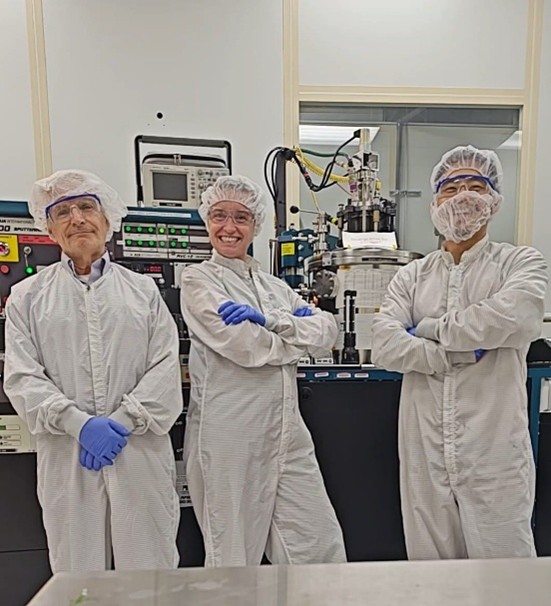
Khanjur Advisor, Dr. Don Schmadel (left), CEO Dr. Sabrina Curtis (middle) working with University of Maryland Ph.D. student, Sheng-Wei Wang.
A: My Ph.D./ Dr.-Ing. research focused on developing novel microelectronics and hybrid electronics devices using shape memory alloy materials for sensors, actuators, and active substrates stretchable/ flexible/ conformal electronics. I founded Khanjur to address a major gap in the market: the lack of scalable manufacturing for these advanced materials.
Joining NextFlex was a natural step for us. We were drawn to the strong community of manufacturers, researchers, and system integrators working to bring hybrid electronics to market. Through our membership, we aim to collaborate with other members, contribute new materials and manufacturing solutions, and support the development of innovative devices enabled by our technology.
Q: What is a key innovation that will enable widespread adoption of Hybrid Electronics and related technologies, and what application areas are you working in?
A: I was first introduced to stretchable electronics as a Master’s Student intern at the Army Research Laboratory (2016-2018), where I worked with traditional semiconductor materials such as silicon. While these materials can withstand high temperatures, they are brittle and fracture easily under strain. Today, most stretchable and hybrid electronics rely on polymer substrates, which are highly elastic but cannot tolerate extreme thermal or mechanical environments.
Through my Ph.D./ Dr.-Ing. research and now through Khanjur’s innovative technical direction, I have focused on introducing shape memory alloys as a new class of structural and functional materials for hybrid electronics. These materials combine high-temperature stability, steel-like strength, and polymer-like stretchability in a single platform.
Khanjur’s patent-pending manufacturing techniques are directly compatible with standard hybrid electronics fabrication processes and enable conformal, mechanically robust devices. Our team is particularly excited about applications in conformal sensors, soft robotic actuators, adaptive structures, and multifunctional substrates that can directly interface with hybrid electronic systems.
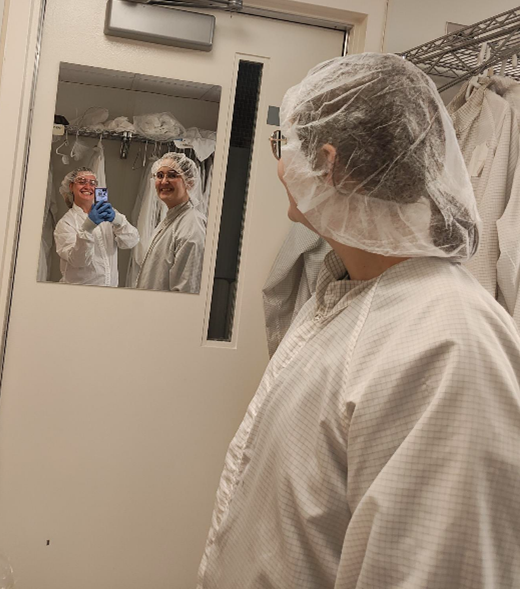
Khanjur CEO Dr. Sabrina Curtis working with Khanjur’s Advisor Dr. Lisa Hanke in the University of Maryland cleanroom.
Q: What upcoming activities are you most excited about?
A: I am especially excited about Innovation Days 2026. This event provides an excellent opportunity to strengthen relationships within the NextFlex community, explore new partnerships, and identify collaborative opportunities that combine our manufacturing capabilities with complementary technologies from other members.

Khanjur CEO, Sabrina (right), networking in DC with Nextflex member Nichole Romine, Senior Project Engineer at Fabric8Labs.
Q: In what ways do you think NextFlex and hybrid electronics can impact microelectronics manufacturing and/or your own product development?
A: Khanjur is focused on manufacturing critical components based on shape memory alloy materials to enable the realization of high-performance, dual-use products. NextFlex plays an important role in connecting innovators, manufacturers, and end users across the hybrid electronics ecosystem.
Through our membership, we aim to continue to build strong partnerships with companies facing challenges related to substrates, actuation, and mechanical integration. By combining our materials and manufacturing expertise with system-level development efforts, we can help bring advanced products to market.
Our long-term goal is to become a trusted, go-to manufacturing partner for high-volume, customer-specific hybrid and microelectronic devices, supporting the growth and commercialization of this rapidly evolving field.