


Intern Spotlight: Khanjur R&D
Khanjur R&D is an advanced materials manufacturing company specializing in shape-shifting metals known as shape memory alloys (SMAs). They develop and produce custom SMA materials with tailored properties, thicknesses, and geometries that were previously unavailable to the market. Their manufacturing processes are directly compatible with standard hybrid electronics and semiconductor fabrication methods, enabling seamless integration into commercial and defense systems.
Their core capabilities center on two primary manufacturing platforms: precision laser-based manufacturing and physical vapor deposition to create thin-film SMAs. Together, these technologies allow them to deliver scalable, high-performance components for next-generation micro-electronic, electromechanical, and shape morphing systems.
Khanjur is also committed to workforce development. Launched in 2023, their program introduces high school and college students to advanced manufacturing through hands-on training with industrial laser systems and cleanroom tools. In partnership with the Army Research Laboratory and the University of Maryland, they provide students with early exposure to materials science, research and development, and high-volume manufacturing practices. Khanjur is helping build the next generation of skilled engineers and technologists.
About Caroline Easley:

Headshot of Khanjur Intern Caroline Easley, presently a senior at Walt Whitman High School in Bethesda, MD.
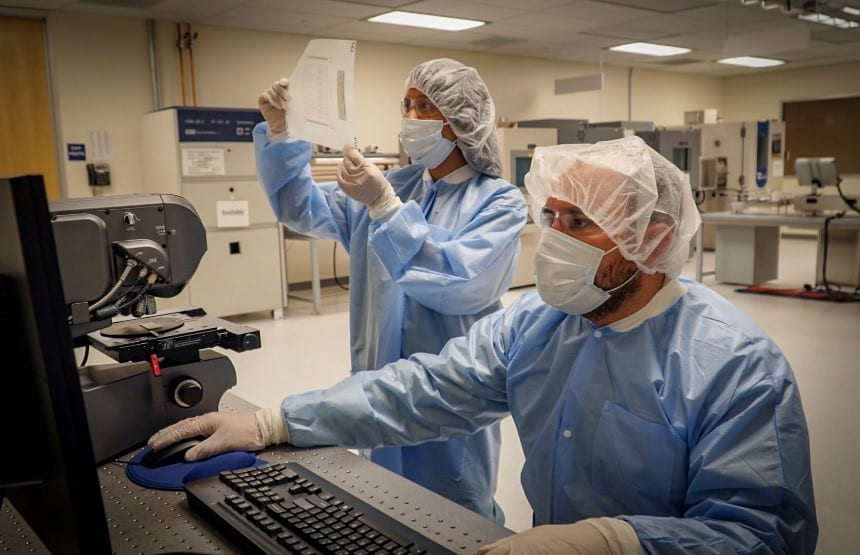
Caroline joined Khanjur R&D as Khanjur intern her sophomore year of high school in 2023. Starting summer 2025, before her senior year, she was hired by General Technical Services, LLC to work as a contractor to the Army Research Lab (ARL) in Adelphi, MD. Caroline continues to work in the cleanroom at ARL to support Khanjur’s active collaboration with ARL.
Interview with Caroline:
Question: What inspired you to pursue an internship in this field?
Answer: In my freshman year of high school, my biology teacher showed me a video of a straight metal rod configuring into a heart after being placed in hot water. I was awed by the capability of the material; I felt like I was witnessing something greater than any science I had learned in school. This material ended up being a shape memory alloy (SMA) manufactured by Khanjur R&D. I desperately wanted to understand the intricacies of the material, so I began an internship with Khanjur. Since then, I have fallen in love with materials science.

Khanjur’s CEO, Dr. Sabrina Curtis (left) and Technical Advisor Dr. Lisa Hanke (middle) working with Caroline (right) on the Khanjur laser system in Summer 2025.
Q: What were some of the projects/tasks that you worked on?
A: I have worked on multiple projects throughout my internship at Khanjur R&D and the U.S. Army Research Laboratory. In the beginning of my time as an intern, I conducted mechanical tests of various shape memory alloy designs using a custom-built test rig at Khanjur R&D’s laboratory. I observed the differences and nuances in different SMA compositions and heating techniques. This information influenced the project I worked on last summer with the Army Research Laboratory: a study on the influence of laser cutting on NiTi serpentine shape memory alloys.
Q: What was the most interesting or exciting aspect of your internship?
A: The most interesting aspect of my internship has been slowly discovering the scientific reasoning behind the magic of shape memory alloys’ behavior. By working with experts in the field and state-of-the-art machinery, I’ve gained a deep understanding of why SMAs behave the way they do and how to optimize their qualities to best perform in real life scientific applications.

Microscope laptop selfie of Khanjur’s CEO Sabrina (left) with intern Caroline (right) in Khanjur’s Lab in Summer 2024.
Q: How did this internship affect your understanding of the hybrid electronics industry?
A: My internship has given me a great understanding of the hybrid electronics industry. I’ve learned about and become knowledgeable in a field of science that has not even been mentioned in my school classes. I understand just how much hybrid electronics can do, and the possibilities they hold for the future.
Q: How has your internship influenced your future education and career plans? What’s next for you?
A: My internship has inspired me to apply to universities with the intention of majoring in mechanical engineering and minor in materials science. I hope to continue researching shape memory alloys once I enter college and make new discoveries that contribute to this incredible field.